






What Causes Medium Voltage Drives to Overheat
A medium voltage drive running a 2,000 HP vertical turbine pump at a municipal water intake station trips on an overtemperature fault at 2:15 PM on the hottest day of the year. The pump goes offline. Reservoir levels start dropping. The drive has run reliably for years, and nothing inside the cabinet looks wrong.
When a properly sized, properly commissioned medium voltage drive suddenly starts tripping on overtemperature after years of service, the cause is almost always in the cooling path: loaded air filters, a failed fan, or an equipment room that is running hotter than it was designed for. Sizing errors, parameter mistakes, and harmonic problems can also make a drive run hot, but those show up at startup and commissioning, not years later on a hot afternoon.
Benshaw has spent more than four decades engineering medium voltage motor control equipment. What follows is a practical breakdown of what actually causes medium voltage drive overheating on pump systems, split into the causes that develop in an established installation and the causes that appear early in a drive's life.
Overheating in an Established Installation
Restricted Airflow and Cooling System Problems
Medium voltage drives dissipate significant heat. A 1,500 HP drive operating at 97% efficiency still generates roughly 35 kW of waste heat, and that heat has to be carried out of the cabinet by cooling air.
Filter loading is the most common reason that airflow drops. In a controlled equipment room, filters load at a steady, predictable rate that follows the site's dust conditions, so a replacement interval based on that site's history keeps the drive well inside its cooling margin. Problems develop when filter changes slip, when a fan fails, or when the intake or exhaust gets blocked by stored material or debris.
A quick check: with the drive running, hold the back of your hand against the intake filter. You should feel noticeably cooler moving air compared to the surrounding room. If you don't, replace the filters and confirm that the fans are running, or investigate why airflow is insufficient.
Ambient Temperature and Equipment Room HVAC
Ambient temperature plays a larger role than many facilities account for. A drive room designed for 40°C ambient that reaches 48°C on a summer afternoon loses a measurable portion of its cooling margin. Every degree above the rated ambient reduces the drive's available output current, which means either derating or a thermal trip. This applies to every drive, regardless of the application. A failed or undersized HVAC unit in the equipment room is one of the most common causes of a sudden overtemperature trip on a hot day.
Benshaw's M2L Series medium voltage drives address room heat load with a transformer that can be located remotely from the inverter. Moving the transformer outdoors reduces the indoor heat load from roughly 394,000 BTU/hr to 119,000 BTU/hr, and moving both the transformer and rectifier outdoors brings it down to about 85,000 BTU/hr, where the specification and site allow it.
When It's the Motor, Not the Drive
On reduced-speed pump applications, the motor is often the component at greater thermal risk. A self-cooled motor's shaft-mounted fan moves far less air at low speed, so a motor that runs for long periods well below base speed can overheat even though the drive is comfortably within its rating.
This is most common on constant-torque loads such as positive-displacement pumps, which demand near-full torque across the speed range. It can also happen on centrifugal pumps when the minimum speed (turndown) is set lower than the motor can reliably cool itself. A separately powered external blower, or a minimum speed limit matched to the motor's cooling capability, solves the problem. In these cases, the motor thermal overload, not the drive, is usually what trips.
Changes in the Process Load
Large centrifugal pumps follow a variable-torque load curve: torque rises with the square of speed, and power rises with the cube. A drive sized for full-speed, full-load operation has a large thermal margin at reduced speeds.
System head does change over time as pipelines foul, valve positions change, or reservoir levels fluctuate. A correctly designed fluid system has a usable operating range from clean to moderately fouled, and operators use that range to know when the system is due for service. If the motor was sized so that it runs at or below about 80% of its capacity at full system load, and the drive was properly sized for that motor, normal shifts in the operating point should not push the drive into an overload condition.
A worn pump will typically need to run faster to do the same work. That may matter for the process, but it does not burden a properly sized motor and drive. The cases where the drive and motor are actually doing more work are higher flow on a centrifugal pump or higher system pressure on a constant-torque pump. Even then, the motor overload will typically trip before the drive does. Evaluating the pump's operating point against its design curve is a job for the pump manufacturer or system designer.
Overheating Problems That Show Up at Startup
The following causes are real, but they appear during commissioning or in the first weeks of operation. They do not suddenly develop in an installation that has been running correctly for years.
Drive Sizing and Specification
An undersized drive will run hot from day one. Constant-torque loads such as positive-displacement pumps need the drive's full thermal capacity even at reduced speed, and that has to be accounted for when the drive is specified. By contrast, changes in fluid properties such as water temperature or solids content have only a small effect on power demand. Going from cold, clear water to warm, muddy floodwater changes the horsepower requirement by roughly 1%.
Parameter and Commissioning Errors
A drive configured with the wrong motor nameplate data or an incorrect V/Hz setting can run hot, and long acceleration ramps on high-inertia pumps can add heat on an undersized drive. These issues surface at commissioning. Torque boost only helps the motor break away at startup, and at the low speeds where it has an effect, a centrifugal pump is not moving product, so operators would notice the lack of flow long before an overtemperature condition developed.
Parameters do matter after a motor replacement or drive swap. Benshaw medium voltage drives and starters log every parameter change, which makes it easy to see what changed and when during troubleshooting. Benshaw's commissioning services verify motor data and application settings at startup.
Altitude
Air density decreases with altitude, and so does cooling effectiveness. A common guideline is a derating of about 1% for every 100 meters above 1,000 meters. At a mining installation at 3,000 meters, that translates to roughly 20% derating, which is typically handled by upsizing the drive. At higher altitudes, insulation is often the bigger concern: thinner air has lower dielectric strength, so maintaining the required BIL rating may call for a higher-voltage-class drive operated at a lower voltage. Both are addressed at specification.
Harmonics, Cable Length, and Input Power Quality
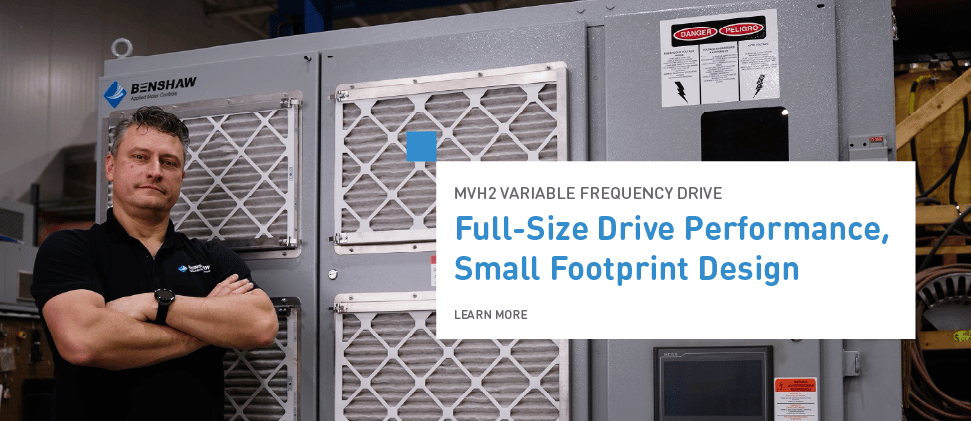
Harmonic heating, reflected voltage at the motor terminals, and carrier frequency trade-offs are significant concerns on low voltage drives. Medium voltage drives built on multi-level, series-connected power cells, such as Benshaw's MVH2 Series drives, produce a near-sinusoidal output, so motor harmonic heating and reflected-wave stress are minimal until cable runs reach several hundred feet. Carrier frequency has a much smaller effect on medium voltage drives and is not adjusted based on speed or load.
Input voltage imbalance does not create output current imbalance. The drive converts incoming power to DC before generating the output, which isolates the motor from the characteristics of the incoming three-phase supply. Within each output phase, the power cells are connected in series and carry the same current.
IEEE 519 is an input-side standard that limits the harmonic voltage and current distortion a drive returns to the facility's electrical supply. It is a power quality requirement, not a measure of internal drive heating or output waveform quality. None of these factors (carrier frequency, cable length, reactors, or input harmonics) change on their own once the drive is installed and operating.
Component Aging: What It Does and Doesn't Cause
A properly designed medium voltage drive that is kept within its specified environment should be expected to reach a 20 to 25 year service life. Component aging is not a typical cause of sudden overtemperature trips.
As DC bus capacitors lose capacitance, the usual symptoms are lower tolerance of decelerating loads, more motor noise from ripple in the output, and occasional nuisance trips on load transients. They do not cause the drive to overheat. Overcurrent and overtemperature are also separate faults: because of the physical mass of the power components, a brief overcurrent event does not by itself produce an overtemperature condition, and age doesn't change that.
Benshaw's M2L Series uses dry-type film capacitors. Capacitor reforming is only a concern for drives or cells that sit in storage for years, and film capacitors do not require reforming.
Diagnosing an Overtemperature Trip
In an established installation, work from the most likely causes to the least likely:
- Check airflow first. Inspect and replace the air filters, confirm that every cooling fan is running, and make sure the intake and exhaust are clear.
- Check the room. Confirm that the equipment room HVAC is working and that the ambient temperature is within the drive's rating.
- Review the drive's history. Look at temperature warnings and the fault log, and note the operating conditions when they occur. With clean filters confirmed, this usually points to the process condition behind the trip.
- Review recent changes. If a motor, drive, or setting was changed, check the parameter change log against the motor nameplate and the application.
- Check the motor and process. Confirm whether the motor overload, not the drive, is tripping, and whether the pump is moving more flow or working against higher pressure than before.
If the drive is still tripping after filters, fans, ambient conditions, and obvious process issues have been ruled out, Benshaw's field service team can help troubleshoot the drive. Support from the pump or load manufacturer may also be needed to resolve process-side issues.
When to Consider a Drive Upgrade or Retrofit
Medium voltage drive systems are typically expected to last 20 to 25 years. As a drive approaches the end of that range, replacement parts become harder to source, and lead times for new medium voltage drives generally run 5 to 12 months depending on size. It is much better to evaluate an upgrade early than to be forced into one by a failure.
A drive retrofit does not always mean replacing everything. Benshaw offers low and medium voltage retrofit solutions that upgrade only the components that need better performance, which can lower total project cost, particularly where space constraints or new wiring would make a full replacement expensive. The conversation is worth having before the failure forces it.
Frequently Asked Questions
What is the most common cause of medium voltage drive overheating on pump systems?
In an established installation, the most common causes are restricted airflow from loaded filters or failed fans and elevated equipment room temperatures. Sizing, parameter, and harmonic issues can also cause overheating, but they appear at commissioning rather than years into operation.
How do I know if my drive's cooling system is underperforming?
With the drive running, hold the back of your hand against the intake filter. You should feel cooler moving air that is noticeably different from the surrounding room. If you don't, replace the filters and check the fans, or investigate why airflow is insufficient.
Can a medium voltage drive overheat without showing an overcurrent fault?
Yes. Overcurrent and overtemperature are separate protections. Reduced airflow and elevated ambient temperatures can cause an overtemperature trip while current remains well within the drive's rating.
Should I oversize a drive to prevent overheating?
It depends on the application. Oversizing a drive costs more up front, but if it is specified that way it does not add complexity or mask other problems. A larger drive can reject heat slightly better because its power cells run below their rated current, though the HVAC savings usually do not offset the added cost. Input power factor on variable-torque applications stays nearly flat across most of the operating range, so oversizing has little effect on it.
How does Benshaw's M2L Series handle thermal management differently?
The M2L's transformer can be located remotely from the inverter, which allows the highest heat-generating components to be installed outside the conditioned space. Moving the transformer and rectifier outdoors reduces the indoor heat load by up to 78% compared to a full drive system in an e-house. Redundant fans are included in the standard design. Because the M2L uses dry-type film capacitors, a spare power cell can sit on the shelf ready to go the moment it is needed, with no reforming or other maintenance, and rack-out power cells make the swap fast.
When should I call in field service versus troubleshooting internally?
If the drive keeps tripping on overtemperature, or if the cause is not clear after checking filters, fans, ambient conditions, parameters, and load conditions, a field service engagement is warranted.