




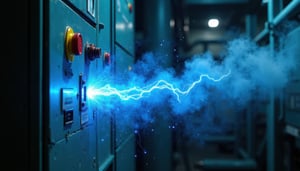
When an internal arcing fault occurs inside medium-voltage equipment, the event unfolds in milliseconds. Temperatures inside the enclosure can exceed 35,000°F — roughly four times hotter than the surface of the sun. A pressure wave radiates outward at the speed of sound. Molten copper vaporizes and expands to more than 67,000 times its original volume. Anyone standing in front of the equipment when that happens is in serious trouble.
This is the scenario arc resistant is built — and tested — to survive. At Benshaw, every piece of equipment in our arc-resistant product line is certified to IEEE C37.20.7, the standard that separates marketing claims from verified protection. Here is why that distinction matters, and why certified arc flash protection should be the baseline expectation for any facility running medium-voltage motor controls.
What Is an Arc Flash, and Why Is It So Dangerous?
Arc flash incidents are not rare events. According to widely cited industry data referenced by the National Fire Protection Association (NFPA) and OSHA, arc flash events occur with troubling regularity in industrial facilities across North America, sending workers to burn centers every year and causing fatalities. The Bureau of Labor Statistics has consistently documented electrical injuries as a leading source of severe occupational trauma, and arc flash is among the most destructive mechanisms.
The physics are unforgiving. When a fault creates an arc between energized conductors — often triggered by something as small as a dropped tool, accumulated dust, animal intrusion, insulation degradation, or a maintenance error — several things happen at once:
- Thermal energy. The arc plasma reaches temperatures that instantly vaporize metal and ignite clothing at distances measured in feet, not inches.
- Pressure wave (arc blast). The rapid expansion of superheated air and vaporized metal creates a concussive blast capable of throwing workers across a room, rupturing eardrums, and collapsing lungs.
- Shrapnel. Components inside the enclosure — busbar fragments, door hardware, panel sections — become projectiles.
- Toxic byproducts. Vaporized copper and burning insulation produce dense, toxic smoke and airborne particulates.
- UV and acoustic damage. The flash itself can cause permanent vision damage, and the sound can exceed 140 dB.
Standard electrical enclosures are designed to keep things in during normal operation — not to contain a 100,000-ampere fault. Without arc-resistant construction, the doors, panels, and seams of conventional switchgear can become the path of least resistance for that energy, directing it outward toward whoever happens to be standing nearby.
What is Arc-Resistant Equipment? How Containment Works
Arc-resistant equipment is engineered around a fundamentally different premise: assume the worst-case internal fault will happen, and design the enclosure to handle it. The goal is not to prevent the arc — that is the job of upstream protection — but to control where the energy goes during the fraction of a second before the protective device clears the fault.
Three engineering principles do the work:
-
Containment. Reinforced enclosures, robust door latching systems, and sealed seams keep arc energy from blowing outward at personnel. Doors do not bow open under pressure. Panels do not peel back. Hinges and latches are designed to hold under blast loading, not just normal handling.
-
Compartmentalization. Internal barriers isolate compartments so a fault in one section cannot propagate into adjacent sections. This limits the scope of damage and preserves the integrity of the rest of the lineup.
-
Pressure relief. Controlled venting — through pressure flaps, channels, or plenum exhaust systems — redirects the expanding gases and ejected plasma to a defined exhaust path, typically upward or to the rear, away from the operator aisle. Benshaw's 40 kA 2B and 50 kA Type 2B designs use a plenum exhaust system to manage this discharge predictably and safely.
Insulated bus systems, included as standard on Benshaw's arc-resistant offering, reduce the probability of an arc initiating in the first place — adding a layer of prevention on top of the containment-and-redirection strategy.
IEEE C37.20.7: The Standard That Separates Tested from “Designed Like”
A manufacturer can call equipment “arc resistant” without any independent verification that it actually performs under fault conditions. IEEE C37.20.7 — Guide for Testing Switchgear Rated Up to 52 kV for Internal Arcing Faults — exists to close that gap. It defines the test methodology, the pass/fail criteria, and the accessibility classifications that let specifiers, safety managers, and engineers compare apples to apples.
IEEE C37.20.7 Testing Requirements: The Five Pass/Fail Criteria
To pass C37.20.7 testing, equipment is subjected to a deliberately initiated internal arc at its rated fault current for its rated duration. The test is not a simulation or a calculation — it is a real fault, with real current, in a real enclosure. Pass criteria are evaluated against five strict requirements:
- Doors and covers do not open. Latches, hinges, and panels must remain closed and in place.
- No parts are ejected. Fragments, hardware, or components cannot be thrown from the enclosure.
- No openings burn through in the freely accessible front, sides, or rear (depending on accessibility type).
- Cotton indicators do not ignite. Calibrated cotton fabric panels placed around the equipment at defined distances and heights must remain unignited — proving that neither flame nor superheated gases reached personnel-occupied space.
- The grounding system remains intact and functional.
Equipment that meets all five criteria earns its rating. Equipment that fails any single criterion does not. Benshaw takes the rating one step further and has UL Solutions witness the testing. Benshaw equipment tested and rated to IEEE C37.20.7 is listed in the Benshaw UL file to prove that the equipment meets the ratings.
Type 2B Arc Resistant: What the Classification Actually Means
The “Type 2B” designation on Benshaw's arc-resistant equipment carries specific meaning under IEEE C37.20.7:
- Type 1 equipment provides arc-resistant protection only on the front.
- Type 2 equipment protects the front, sides, and rear — all four sides where personnel might be working.
- The “B” suffix indicates that the low-voltage door is open during testing. This ensures that personnel working in the low-voltage cabinet during an arc event are protected.
40 kA vs. 50 kA Arc Resistant Ratings: Which Do You Need?
Benshaw's arc-resistant designs are certified at two fault levels:
- 40 kA, 0.5 seconds, Type 2B
- 50 kA, 0.5 seconds, Type 2B
Benshaw's Type 2B 40 kA product line is UL Listed under designation 4P (40 kA Plenum), NEMA 1, with a standard 36" deep cabinet, bottom cable entry and exit, and a top plenum exhaust adding 19" of height and 2" of width to the lineup. Side exit (left or right) is standard; custom rear exit is available, engineered-to-order. The product line accommodates enclosure widths from 20" through 45", including main-lug-only (MLO), across-the line, and solid state starters. Type 2B allows the operator to safely work in the low-voltage section and be protected from an arc event.
The kA figure represents the available short-circuit current that the enclosure must withstand during the arcing event. The 0.5-second duration is critical — it represents the upper bound of time the equipment is rated to contain the fault before upstream protection clears it. Half a second sounds short, but at 40,000 or 50,000 amperes of arcing current, the energy released in that window is enormous. Equipment rated only for shorter durations leaves a narrow margin if a protective device operates slowly or a backup trip is required.
Specifying equipment rated to your facility's actual available fault current — not below it — is one of the most consequential safety decisions a project engineer makes.
When is 40kA the Right Specification?
A common procurement reflex is to spec the higher-fault-rating "just in case." But 40 kA equipment is engineered for a large class of installations where the available fault current genuinely does not exceed it, and specifying 50 kA in those cases adds cost and footprint without adding safety. Benshaw's 40 kA, Type 2B design fits a standard 36" deep cabinet, while most 50 kA offerings on the market require 48"–50" deep cabinets, and require larger plenums for exhausting.
40 kA is typically the correct rating when:
-
The maximum available fault current at the equipment location is below 39 kA
-
The source is impedance-limited (smaller utility feeders under ~15 MVA, long medium-voltage feeder runs, high-impedance grounding)
-
The system is generator-dominated, limiting the available fault current
-
The installation sits downstream of current-limiting reactors, limiting the available fault current
-
The project is a retrofit or an addition to an existing MCC lineup where utility service is fixed
50 kA becomes the right call when utility data is uncertain or conservative ("up to 63 kA possible"), when transformer impedance isn't firm, or when planned system expansion — a larger transformer, additional feeders, or a tie-in to a stronger source — could push fault current above 40 kA over the equipment's service life.One useful technical note: because arc energy follows an I²t relationship, Benshaw's 40 kA, 0.5-second rating also satisfies the 25 kA, 1-second rating — giving specifiers margin on slower-clearing protection schemes.
Arc Resistant vs. Non-Arc Resistant Equipment: How They Compare
The case for arc-resistant equipment is not just about the fault event itself. The differences play out across personnel safety, fault handling, equipment damage, downtime, maintenance access, and long-term cost of ownership. Non-arc resistant equipment may meet basic electrical standards, but it does not contain or redirect arc energy — meaning the operator aisle becomes part of the fault's exhaust path.
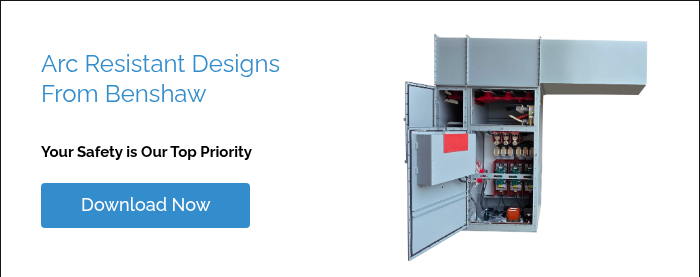
For a side-by-side comparison of the two equipment types in terms of safety, fault handling, compliance, and total cost of ownership, see Benshaw's Arc-Resistant Designs brochure (LIT-10028).
How Arc Resistant Equipment Supports NFPA 70E and OSHA Compliance
Arc-resistant equipment is not just a piece of hardware; it is a component of a broader electrical safety program. It interacts with several standards and regulatory frameworks:
- NFPA 70E (Standard for Electrical Safety in the Workplace) establishes requirements for arc-flash risk assessments, PPE selection, and safe work practices. While NFPA 70E does not mandate arc-resistant equipment, equipment that contains and redirects arc energy meaningfully reduces the incident energy a worker is exposed to in adjacent compartments and during certain tasks, which can influence PPE category requirements and work permit conditions.
- OSHA 29 CFR 1910 Subpart S governs electrical safety in general industry and requires employers to protect workers from recognized electrical hazards. Specifying tested, certified equipment is consistent with the hierarchy-of-controls approach OSHA expects — engineering controls (containment) sit above administrative controls (procedures) and PPE.
- IEEE 1584 provides the calculation methodology for arc flash incident energy. Arc-resistant equipment changes the boundary conditions for many of those calculations, particularly for tasks performed on the exterior of a closed, latched enclosure.
- CSA Z462 is the Canadian equivalent of NFPA 70E and references arc-resistant equipment in similar terms.
The point is not that arc-resistant equipment is a regulatory shortcut. It is not. The point is that certified equipment is the engineering control that makes a serious electrical safety program coherent — a foundation that everything else builds on.
Type 2B Accessibility and Safer Maintenance Practices
A frequently overlooked benefit of arc-resistant Type 2B equipment is what it enables during the equipment's operational life, not just during a fault event.
Conventional medium-voltage equipment typically requires full de-energization for routine inspections, infrared scans, and many maintenance tasks. De-energization means production downtime, lockout/tagout procedures, and — in some facilities — coordination across multiple shifts and departments. The friction discourages frequent inspection, and missed inspections are a leading contributor to the conditions that lead to arc flash events.
Type 2B equipment allows safer access to certain compartments while energized (within the manufacturer's specified procedures and applicable safety practices). This means more frequent visual inspections, easier thermal imaging, and a lower barrier to catching the warning signs — loose connections, discoloration, dust accumulation. Safety improves not just because the enclosure can contain a fault, but because conditions that cause faults get caught earlier.
The Total Cost Argument for Arc-Resistant Equipment
Arc-resistant equipment carries a higher upfront cost than non-arc-resistant alternatives. There is no useful purpose in pretending otherwise. What changes the calculation is everything that follows the purchase:
- A single arc flash incident at a medium-voltage installation can result in seven-figure direct costs: emergency response, equipment replacement, business interruption, OSHA investigation, and — most consequentially — worker injury or death.
- Insurance carriers increasingly factor arc flash mitigation into industrial property premiums.
- Recovery time after an internal fault in arc-resistant equipment is typically a fraction of that in non-arc-resistant equipment, because the damage is contained. A higher purchase price is recoverable. A worker's life is not.
What to Ask Suppliers When Specifying Arc-Resistant Equipment
When evaluating arc-resistant medium-voltage equipment, the questions that matter are specific:
- Is the equipment tested to IEEE C37.20.7, or only “designed in accordance with” it? Tested means a third-party-witnessed fault test. Designed in accordance with means nothing verifiable.
- What is the accessibility type — 1, 2, 2B? Does it match where your personnel actually work?
- What is the rated short-circuit current and duration, and does it match your facility's available fault current and protective device clearing time?
- Is the insulated bus standard or optional? (On Benshaw's offering, it is standard.)
- What is the exhaust path — top vent, rear vent, plenum? Does it work with your room layout and clearances?
- Will the manufacturer provide the test report for review, or is the equipment rating in a 3rd-party file, such as UL Solutions?
Vague answers to specific questions are themselves an answer.
Benshaw Arc Resistant Motor Control Solutions
Benshaw builds arc-resistant medium-voltage solid-state starters and across-the-line (ATL) starters tested and certified to IEEE C37.20.7 at both 40 kA and 50 kA, 0.5 seconds, Type 2B. Configurations are available at 2300 V, 3300 V, and 4160 V for motor applications from 150 HP to 3500 HP. Our equipment is designed for the realities of industrial environments — robust door latching, controlled pressure relief, compartmentalization that limits fault propagation, and accessibility that supports the maintenance practices.
Safety is not a feature we add. It is the design constraint around which everything else is built. Certification is not a marketing claim — it is documentation that the equipment did what we said it would do, under conditions defined by an independent standard, witnessed and recorded.
When the worst day happens at your facility, the difference between certified arc-resistant equipment and equipment that merely looks similar is the difference between an incident you recover from and one you do not.
That is why the testing matters. That is why we do it. That is the Benshaw promise.